
Daiya: A Kanna Plane Maker’s Katsuobushi Shaver
Our visit took us to Sanjo in Niigata Prefecture, home of Yamatani Seisakusho, the workshop behind Daiya, a brand of katsuobushi (dried bonito) shavers. The company's main trade is making kanna — the hand planes used by Japanese carpenters. Why would a plane maker create a bonito shaver? We asked Mr. Yamatani, the managing director, who led the launch of Daiya and is a craftsman himself, and toured the workshop to find out.

Tsubame-Sanjo: a town of metalwork
Sanjo and the neighboring city of Tsubame are known together as Tsubame-Sanjo, one of Japan's great production areas for knives, hardware and cutlery. Both cities share the same roots: wakugi, traditional hand-forged Japanese nails.

Before Western nails arrived, every nail used in Japan was forged by a blacksmith. Today wakugi are used mainly to restore temples and shrines.

As demand for wakugi declined, Sanjo used its forging skills to make blades and tools, while Tsubame turned its hammering skills to hammered copperware and Western cutlery. Today it is said there is no metal product Tsubame-Sanjo cannot make.
A maker of plane bodies since 1946
Yet Yamatani Seisakusho is not a blacksmith. Since its founding in 1946 it has been a woodworking business, making the dai — the wooden body of a kanna plane that you hold in your hands. In Japanese, a maker of plane bodies is called a "daiya", and that is where the brand name comes from.

Blade and body: two halves of one tool
A kanna is made of a blade and a wooden body. The workshop makes the body and buys the blades from blacksmiths. People tend to think the blade is everything, but a blade only cuts at its best when the wooden body is made with real skill.
Every blade is slightly different, and it is the wooden body that is adjusted to fit each one perfectly. There is no manual for this adjustment — it relies on the craftsman's feel.

The number of such craftsmen is shrinking: there were once around 70 kanna makers, and now only a handful remain. Japanese planes can still be made here because Sanjo has both the blacksmiths and the woodworkers — the strength of a production region.
From kanna to katsuobushi shaver
Workshops like this one usually work behind the scenes as subcontractors, which leaves them exposed to changes they cannot control. With fewer wooden houses being built and power tools replacing hand planes, demand for kanna is falling. So the company decided to develop its own product and brand, built on its own strengths.
You may have noticed that a kanna and a katsuobushi shaver are almost the same tool. Turn a kanna upside down and it becomes the cutting part of a shaver.


For years the workshop had made the cutting parts of shavers for other companies. Then Mr. Yamatani decided: "Let's make a katsuobushi shaver that only we can make." Using everything they knew, they developed a shaver for the modern dining table.
What only they can make: carved from a single block
Traditional shavers are boxes assembled from wooden boards, with a drawer to take out the flakes.

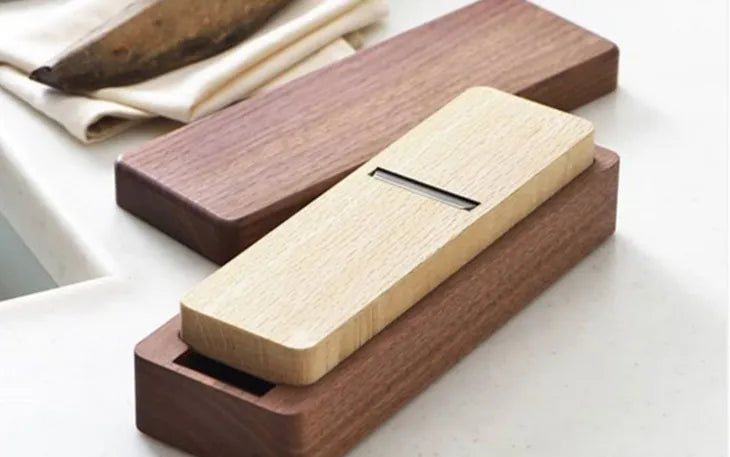
Daiya's shaver is not assembled — it is carved out of a solid block of wood, something only a workshop that has carved wood since its founding could do.

With no joints it is hygienic and very compact. Above all, carved wood is simply beautiful — it feels good in your hands.
What only they can make: the right materials

The boxes come in brown walnut or white beech, while the plane that shaves the bonito is Japanese white oak. Softer wood would quickly dent; harder wood would be difficult to work. White oak is just right — the same wood used for kanna, and made in almost the same process. The blade and body are adjusted by experienced craftsmen.

Solid-wood carving skills, carefully chosen materials and the know-how to adjust a blade: that is why this shaver could only come from Yamatani Seisakusho.

In the workshop: drying the wood
First we saw the drying area for white oak, in a separate building.

All the white oak is dried naturally and slowly over several years. Careful drying keeps the wood from changing color, warping or twisting later.

Even blocks cut to the same size change differently over time depending on the part of the tree. Turning a natural material into a product takes a great deal of unseen time and care.
In the workshop: carving
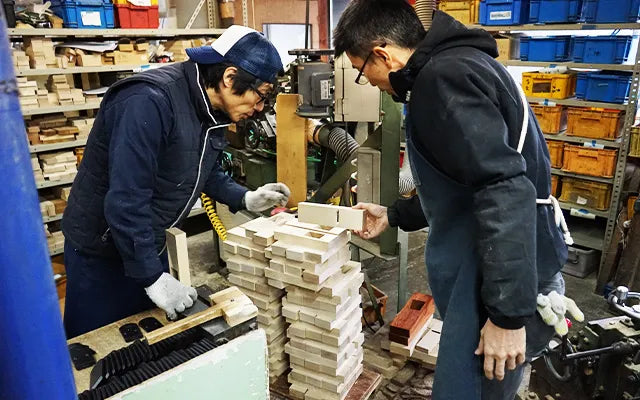
The dried white oak is cut to size, and the opening for the blade is roughly shaped by machine.


Then a craftsman refines the details with a chisel.


In the workshop: fitting the blade
Next, each blade and body are fitted together one by one. Every blade differs in ways the eye cannot see, so the craftsman adjusts the wood again and again by feel. A blade and its body become a matched pair — to change the blade, the body must be adjusted too.


After a final adjustment, the cutting part of the shaver is complete. It is then combined with a separately carved box.

Two blades: SK and Aogami
Daiya offers two blades, both used in professional carpenters' planes.

- SK — a high-quality plane blade made in Sanjo by laminating SK5 carbon steel with iron. It is easy to sharpen yet holds its edge, at a reasonable price. Many steps are done by machine.
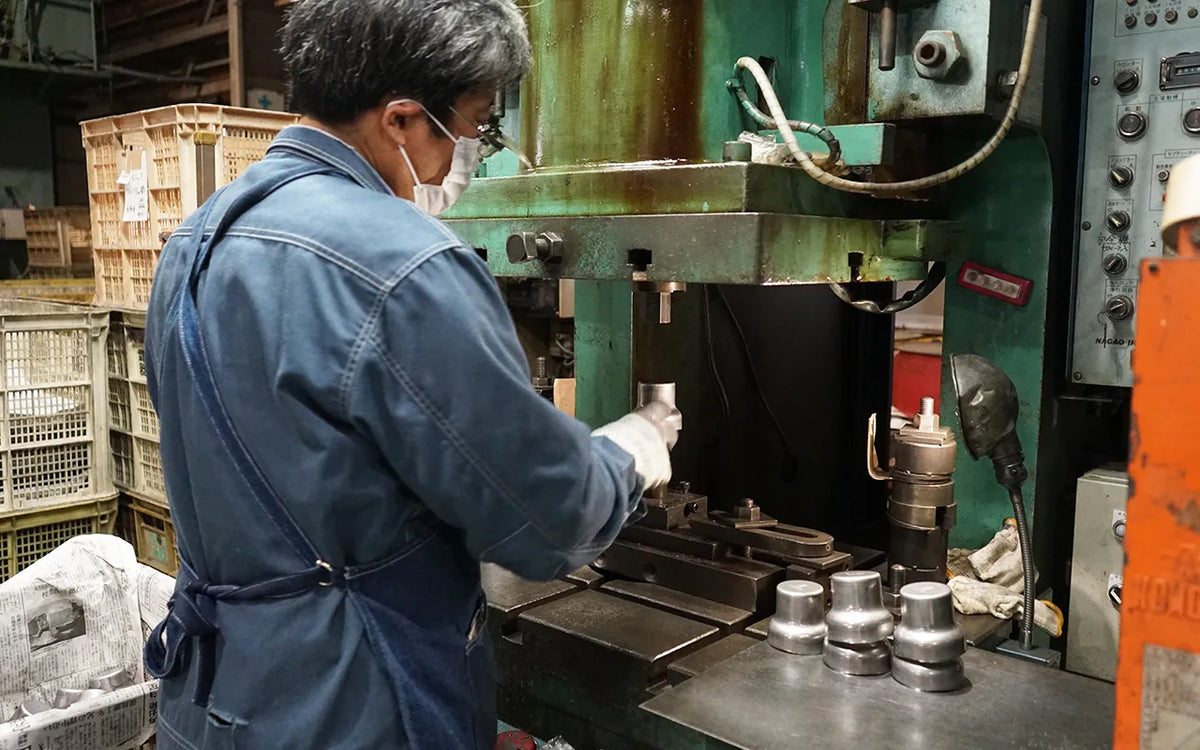
- Aogami (blue paper steel) — forged by craftsmen in Yoita, Niigata. Impurities are removed from the steel and tungsten and chromium are added, greatly improving wear resistance. It is classed as a premium steel, and almost every step is done by hand.

The true taste of katsuobushi
Many people now use bonito flakes from small packets. Freshly shaved katsuobushi has far more aroma and flavor — and tasting it at our own table with a Daiya shaver was a moving experience.

We hope more people around the world will discover Japan's dashi culture. Our sincere thanks to Mr. Yamatani and everyone at Yamatani Seisakusho for their cooperation.


%20shavers.%20The%20company's%20main%20trade%20is%20making%20kanna%20%E2%80%94%20t...)