Kamoshika Doguten: Banko Ware Tools for a Whole Region
Komono, in Mie Prefecture, is a hot-spring town at the foot of the Suzuka Mountains, famous for the wild Japanese serow, or kamoshika, that lives there. Near Mt. Gozaisho, the tallest of the range, Yamaguchi Toki, a maker of Banko ware, runs Kamoshika Doguten, a regional brand of kitchen tools that brings joy to the table.

Its shop in Komono is easy to spot from a distance. Yamaguchi Toki is also one of the four Banko ware kilns behind 4th-market, so visitors can buy both brands there, and workshops are held by reservation.

What it takes for a craft region to survive
Mr. Yamaguchi joined the family business around 2003, leaving his job as an office worker. When he told his father, then the president, that he wanted to take over, his father said: "Don't. Just don't." The Banko ware industry was in decline, and he did not want his son to inherit it.

Those words only fired him up. If things were bad, he would make them better. Inside the company, he saw the reality: mostly subcontract work, at the mercy of clients' fortunes and raw material prices, every month a struggle. Other Banko kilns were in the same position, and the region had no future like this. He set out to reduce the company's dependence on outside forces.

One step was launching 4th-market in 2005, selling directly from makers to retailers and scaling back business with wholesalers. It meant building new sales channels, but it put the company in control of everything from making to selling. Some in the industry looked on coldly. "I didn't worry about it," he says. Focused on keeping the region alive, he had no time to.
A brand for the whole region
A few years later, he launched Kamoshika Doguten, named after the serow, the official animal of both Mie Prefecture and Komono. He insists it is a regional brand, made for the region.

That shows in an unusual choice. Most kilns make their own brand in-house. Kamoshika Doguten asks partner kilns to make many of its products, even ones Yamaguchi Toki could make itself. The partners were surprised at first. "The whole region has to thrive," Mr. Yamaguchi explains. Some kilns have better skills in certain areas, or can make easily what would take his team great effort. If those makers disappear, Banko ware will one day have no craftspeople left. It is almost as if he is managing the region, not just a company.

When we visited a partner kiln, a planning meeting broke out on the spot. "Could you make this?" "Let's do this for the next Kamoshika product!" They were laughing like children deciding what to play.
Bringing energy back to the area
Asked about his goals, Mr. Yamaguchi answered not for his company, but for the region. He has worked with people from many fields to revitalize Komono, Yunoyama, Yokkaichi and the surrounding area. "Right now these are still dots. I want to connect them into something bigger, so this area draws people in on its own."

The shop is designed to be a gathering place for locals and visitors alike. In its workshop area, you can choose from many molds, shape the clay and pick a glaze: a real taste of craftsman-style production. There have even been events cooking the season's new local rice in Kamoshika's rice pots.

Making the rice pot
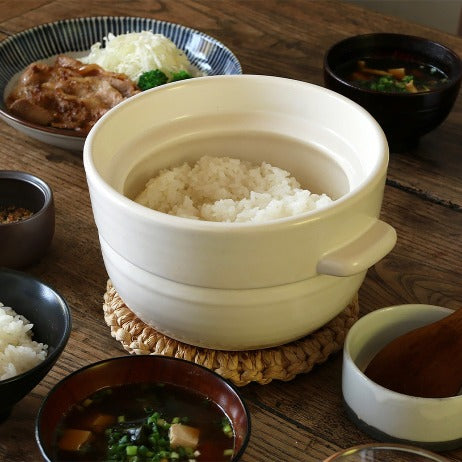
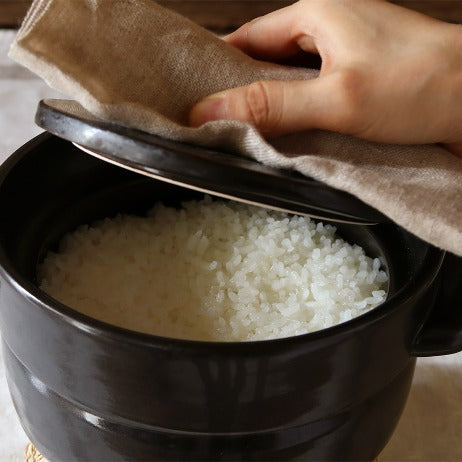
Every Kamoshika product is clean in design and highly functional, true tools. We watched one of the most popular being made: the Gohan no Nabe, a clay rice pot that can also be used in the microwave.
- Forming. Clay is weighed, placed in a mold, and shaped by a machine set specifically for this pot.
- The inner ledge. The key feature is a ledge inside the pot. It helps prevent boiling over, lets the lid sit easily, and makes storage simple. Making this shape needs a specially shaped machine and movement, and only Kamoshika Doguten can make it.
- Shaving. The outside is thinly shaved. This gives the surface a warmer texture, and the slight unevenness increases the surface area, so the pot absorbs heat more efficiently. It is difficult work; since a craftsman retired, Mr. Yamaguchi is the only one who does it, starting at 4 a.m.
- Handles and drying. Handles are attached by hand, then the pots dry upside down to keep them from warping as they shrink.
- Bisque firing at about 750–800°C drives out moisture so the glaze adheres well.
- Glazing and firing at about 1,150–1,250°C completes the pot.


Every step involves human hands, not for its own sake, but because this is the only way to make something this good, while still keeping the price within reach.
At a partner kiln
We also visited the partner kiln that makes the Suribachi, one of the brand's best sellers. Unlike a traditional Japanese grinding bowl, it has no grooves, yet it grinds well, is easy to wash, and doubles as a serving bowl. Demand is so high that the kiln can barely keep up.

Clay is pressed into a mold and spread evenly with the thumbs on a spinning wheel, a satisfying sight. After drying, the outside is lightly shaved, and the spout is formed with a swift karate-chop of the hand. Iron powder is scattered before glazing to create the rough grinding surface inside.

The joy of making
What we felt most on this visit was that good things come from makers who enjoy their work, and enjoying it takes companions. Kamoshika Doguten has them, inside the company and out, arguing and laughing their way to new ideas. And by speaking up for their region, they are drawing more and more people in. We look forward to every new tool they make, and to watching the Banko ware region change. Our thanks to Mr. Yamaguchi and the team for a long and generous visit.