文章: Asakura Senpu: NAGARE, the Super Water-Repellent Furoshiki from Kiryu

Asakura Senpu: NAGARE, the Super Water-Repellent Furoshiki from Kiryu
In Kiryu, Gunma Prefecture, a city that has thrived on textiles for centuries, the dyeing company Asakura Senpu has given the traditional Japanese wrapping cloth, the furoshiki, a new life. Their brand NAGARE combines this age-old cloth with modern technology and design, aiming to bring a new and beautiful way of living through something people have used in Japan for generations.

The same furoshiki, but a different thing
NAGARE looks like a furoshiki, yet it behaves like nothing you have used before. The reason is its super water-repellent finish.
What is the super water-repellent finish?
Asakura Senpu uses its own technology, dewelry®. Each fine fiber is individually coated with nano-sized fluorocarbon particles, giving the cloth a remarkable water repellency that is very hard to imitate. The repellent agent used is an environmentally friendly type that does not contain PFOA.
Water-repellent is not the same as waterproof
A waterproof finish coats the whole fabric to stop water getting in. It fills the gaps between the fibers, so the cloth loses its breathability and natural texture.
A water-repellent finish, by contrast, treats every single thread so that it sheds water that is not under strong pressure. Because dewelry® does not coat the whole cloth, the weave stays open and air and vapor can pass through. It does not feel stuffy, so it also works well as a scarf or a lap blanket.

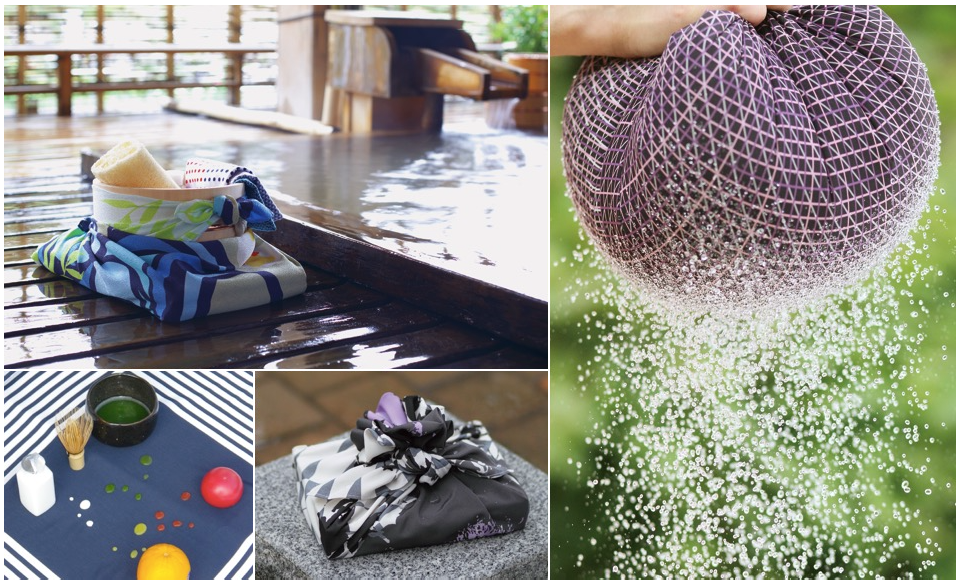
Outdoors, squeeze it and water comes through the gaps like a shower; hold it without pressure and you can carry water like a bucket.

“Super” water-repellent has a real definition
The term is not just a marketing word. A surface is called super water-repellent when water droplets sit on it at a contact angle of more than about 150°. On NAGARE the contact angle is 160°, while ordinary water-repellent fabric is around 110°. The higher the angle, the rounder the droplet becomes and the more easily it rolls away.


It works much like the non-stick coating on a frying pan, so stains also have a hard time sinking in.
A finish that lasts
dewelry® is also highly durable. Even after 50 washes it keeps Grade 4 or higher on the five-level JIS water-repellency test, whereas conventional finishes drop to Grade 2 or lower. In normal use it keeps repelling water even after 100 washes. (Please avoid bleach, which degrades the finish.)

So, how will you use your furoshiki?
You can of course use it as a classic wrapping cloth. But keep it in your bag for a sudden shower, wear it as a scarf when it gets chilly, take it outdoors to protect your gear from rain or to carry water, spread it as a stain-resistant tablecloth, or use it as an eco bag for shopping.

Forget the old image of the word “furoshiki” and find your own way to use it. Drawing on the nagare (flow) of the past while creating a new flow for the culture of the furoshiki, that is the spirit of NAGARE by Asakura Senpu.
We would like to thank Asakura Senpu for their cooperation.