SHINTO TOWEL: The Ultimate Towel from Senshu, Osaka
Senshu, in southwestern Osaka, is where towel making in Japan began. Here we visited Shinto Towel, founded in 1907, and its president, Mr. Shinto. While continuing to make traditional Senshu towels, the company launched its own brand, SHINTO TOWEL, in 2017: towels with an unforgettable softness and a simple design that catches the eye.


Imabari and Senshu
Japan's two great towel regions are Imabari in Ehime and Senshu in Osaka. "Senshu towels are mostly white and plain, but very soft and absorbent. Imabari excels at jacquard patterns and design," Mr. Shinto explains. Imabari is far better known; "they're great at marketing, and that's a lesson for all of Senshu." But today, a regional name alone is not enough. Similar products flood the market, so each maker needs its own identity. "Young makers like us focus on our own brands, and hope that lifts Senshu as a whole."

A design that changed everything
About ten years earlier, for a project pairing Kansai companies with creatives, he handed an Osaka design studio a sample of his 2.5-layer gauze. The studio came back with the tagged design used today. "It was a shock. It was so cool!" he laughs. Years later, as president, he joined a prefectural support program, where by chance an adviser he already knew helped with marketing, and the same studio handled design. "It was the luckiest moment of my life."

Three ultimate towels
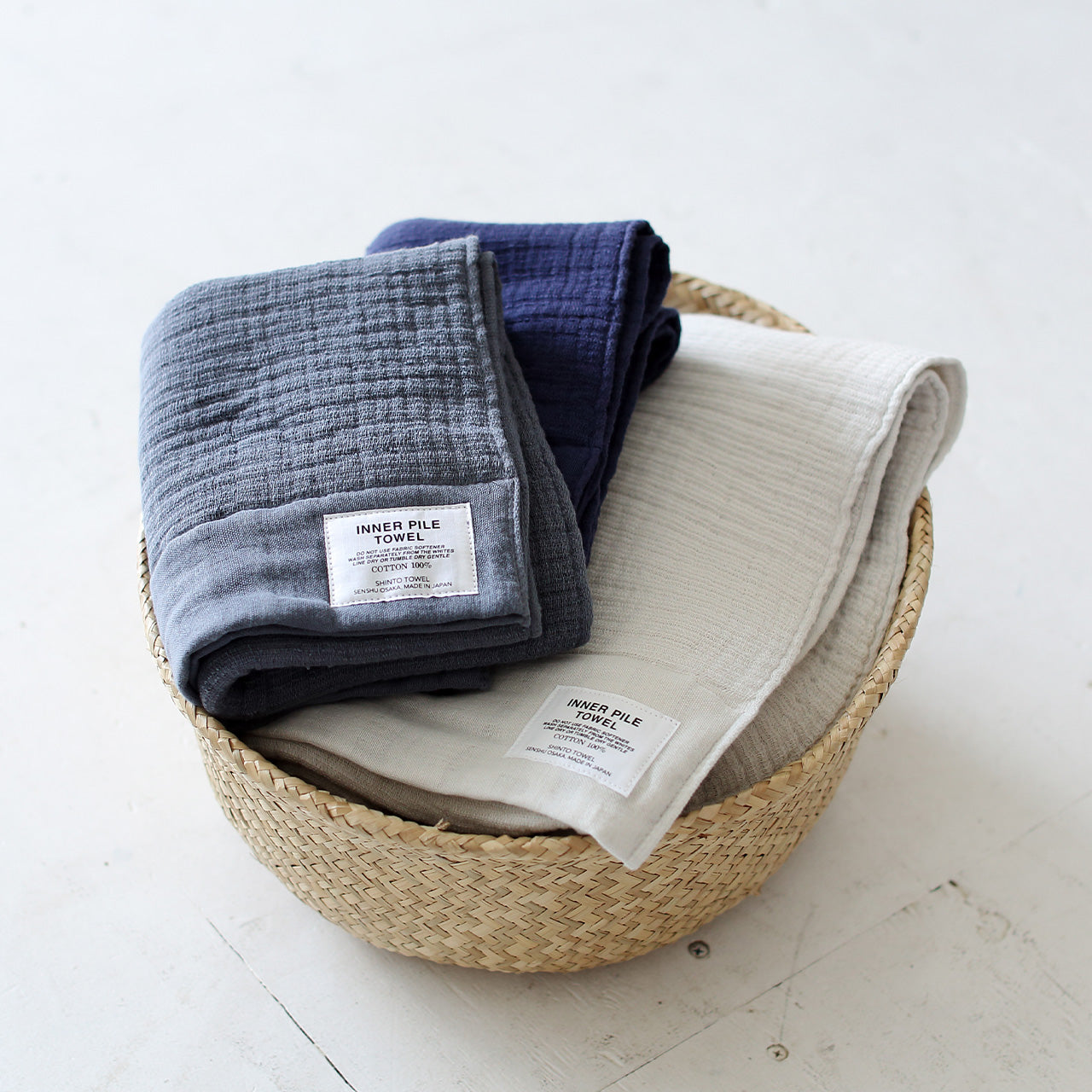
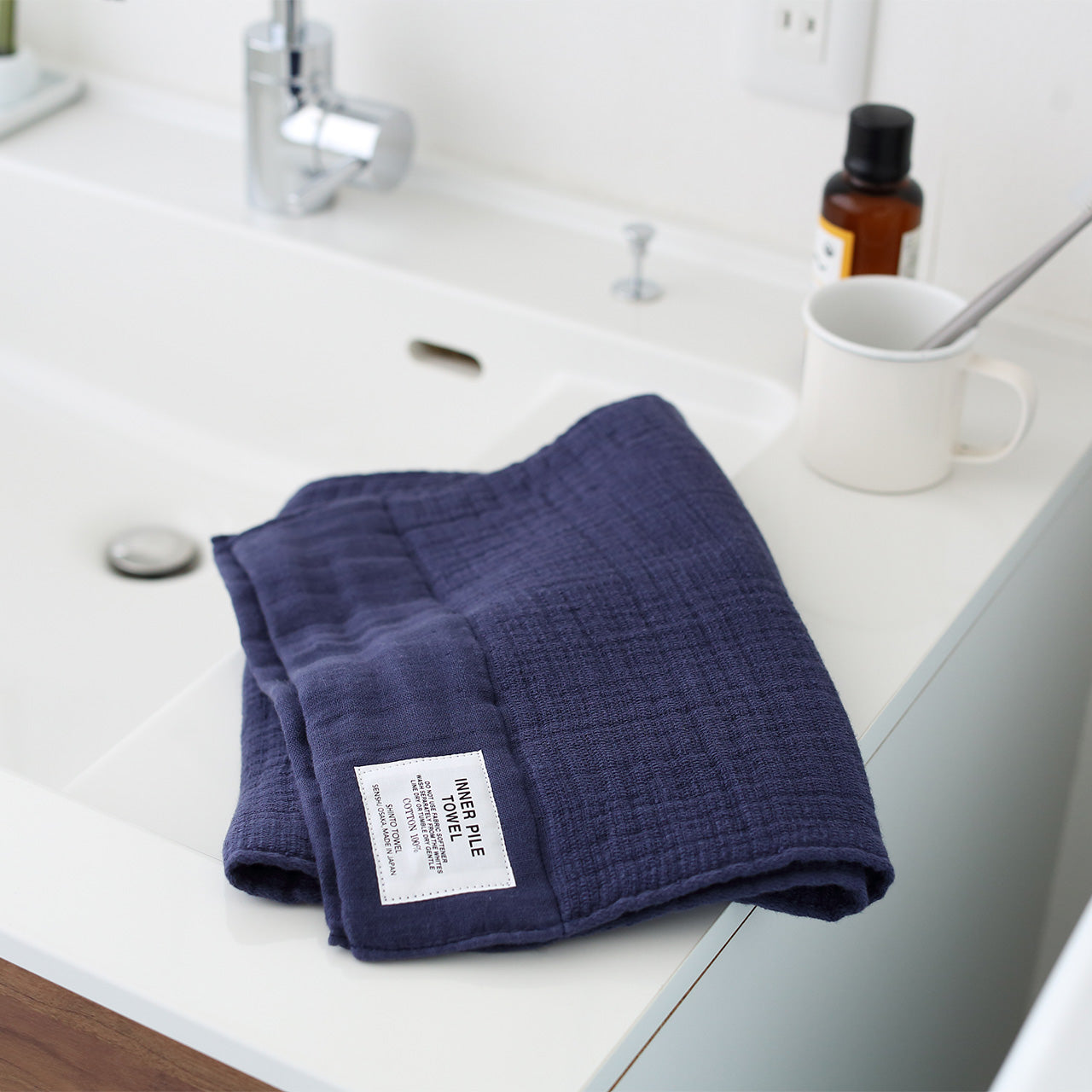
- Inner Pile. Pile sandwiched between layers of gauze, woven slowly on old shuttle looms. Light, soft gauze with the plush volume of pile: you will want to press it to your cheek. Lovely as a towel, pillow cover or light blanket.
- 2.5-layer gauze. Three layers of gauze, with the middle one deliberately woven loosely, so the fabric stays soft and full of character instead of lying flat. Slightly different warp and weft colors give depth. Light, quick-drying and never stiff.
- Yukine. A towel that squeaks like fresh snow when you squeeze it. Its secret is atozarashi, Senshu's technique of bleaching away natural oils and starch after weaving. Yukine takes about twice the usual time, so it is remarkably absorbent from the very first use.


"To me, all three are the ultimate form of a towel," says Mr. Shinto. "Use them however you like: take one outdoors to wrap up when it's cold, or to wipe up a spill."
Three generations of looms
Shinto Towel runs three generations of looms. The newest are computer-controlled air-jet looms, too fast to follow by eye. The previous generation passes the weft with rapier rods, guided by plastic pattern cards punched one hole at a time. The oldest, built in 1982 and modified for Inner Pile, throw the weft with a shuttle, loudly and impressively, guided by chains of wooden slats.


There are eight of these shuttle looms, and their parts are no longer made. "We do all the repairs ourselves, but honestly I don't know how long we can keep them going. We have a duty to carry on this craft, so we're experimenting with making Inner Pile on newer looms." Each SHINTO TOWEL tag is sewn on by hand.

"I have no sense for design," Mr. Shinto says. We disagree: choosing an unprecedented design simply because it is cool is real sense. Like many makers we meet, he is humble, trusts others, and draws people to him. Carrying on more than a century of tradition while creating new value with others, that is how these wonderful towels were born. Our thanks to Mr. Shinto for his time.