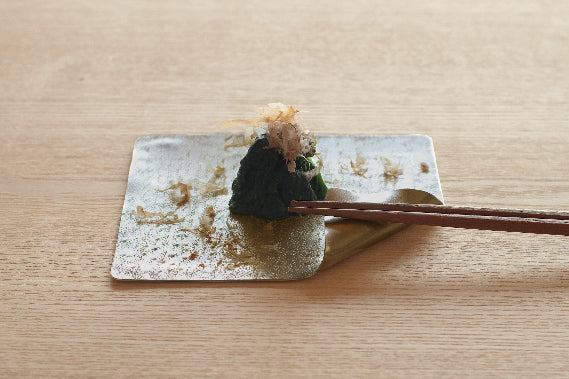
syouryu: Suzugami, Tin Shaped by a Bell-Maker's Hammer
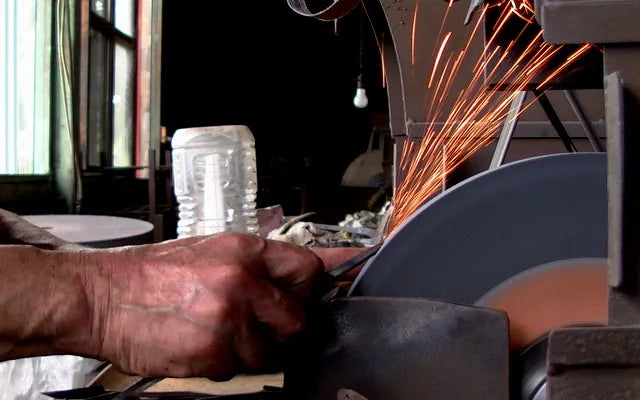
syouryu is the new brand of Shimatani Shoryu Kobo, a workshop in Takaoka, Toyama, that has specialized in orin, the bowl-shaped bells used in Buddhist temples, since 1909. Of fewer than ten orin craftsmen in all of Japan, three work here. They make bells by hammering metal sheet, shaping it and tuning its sound, and that same hammering is the heart of everything syouryu makes.
The skill behind suzugami
Tin is soft and weak compared with metals like iron. But that softness means it can be shaped freely. Could that quality become part of everyday life? That question was the start of suzugami, "tin paper."

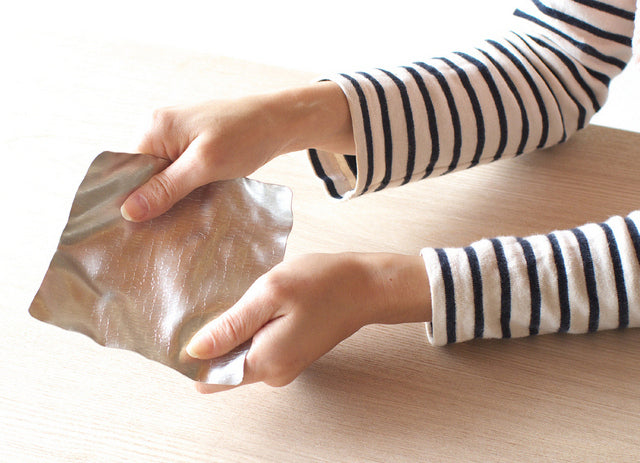
Metal grows stronger when it is worked. The tin is first passed through rollers again and again, getting thinner and stronger each time. Even so, it is still too soft for a product. The final step uses the craft of the orin maker: hammering. Hammering makes the tin stronger still, and leaves a beautiful pattern on its thin surface.

Struck in a steady rhythm, evenly spaced and with equal force, the hammer marks transform the surface. Strike too hard and it breaks down; tilt the hammer and the mark will not form. It is truly difficult, and only years of hammering bells make it possible.
Born in Takaoka
Beneath the Tateyama mountains, Takaoka has long supported Japan's copperware, casting and Buddhist altar crafts. But here, as elsewhere, simply making the same things as before is no longer enough. Takaoka has a group of young traditional craftspeople under 40 who work together to revitalize local industries, and Mr. Shimatani was among them.
At one of the group's exhibitions, he presented suzugami as a new challenge. He never expected the response it received. Word spread quickly, and production could not keep up.

Mr. Shimatani's main work is making orin, mostly the large bells used in temples. At first, he made suzugami alone in the gaps between his bell work and after hours. That soon proved impossible, and today the workshop's other orin craftsmen help make it too. Each sheet is hammered by an experienced craftsman, and carries their care.