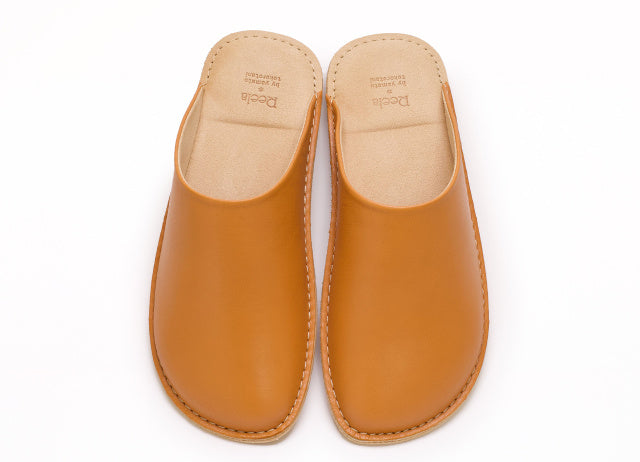
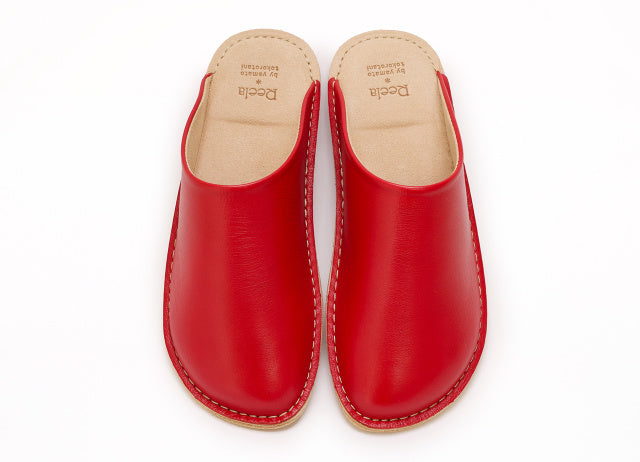
Reela: Leather Room Shoes Shaped Like Fine Footwear
In Ehime Prefecture, Yamato has been making sandals for more than 60 years, well known for its men's sandals. In 2017 it launched Reela, a brand of room shoes. Why would a sandal maker turn to indoor footwear? We toured the factory with Mr. Tanio, the creator of Reela.

A sandal maker devoted to comfort
Since 1963, Yamato has made sandals from start to finish at its factory near the Seto Inland Sea. Its classic men's sandal has sold for over 60 years. "Yamato is famous for being expensive," Mr. Tanio laughs. Behind that is the founder's philosophy: "Men only wear what they love, so we must never let them down." Durability and comfort come first, and the company was among the first to put cushioning into insoles and uppers.

Yamato also made artistic sandals of washi paper laminated with leather, shown in New York, Las Vegas and Paris, which led to work for many famous apparel brands. But as the apparel industry weakened and cheap overseas copies spread, the company shrank. "So we wondered what we could do in Japan": something truly good that could not easily be copied.

How Reela was born
In 2016, Yamato joined a group of Ehime makers at an interior lifestyle trade show. "We only had outdoor sandals. So we thought, let's make some slippers." Knowing it could not win on price, it showed samples at high prices. Of about 30 visitors who exchanged cards, 20 said "too expensive." The other 10 said, "I want to stock these," or simply, "I want them." That was enough to go ahead.

Room shoes shaped on wooden lasts
Every Reela is cut and made by hand at Yamato's own factory. Its defining feature is a step borrowed from sandal making: shaping the leather on wooden lasts. Ordinary slippers are simply cut and sewn; Reela spends two days on lasts, like fine shoes. Only after visiting overseas factories did Mr. Tanio realize how unusual this was. "Are we the only ones doing this?"

Lasting gives precise left-right consistency. "Overseas, often one person makes right shoes and another makes left ones," so sizes can differ. Lasting also makes the sole meet your foot as a surface, which is what makes it so comfortable. Yamato has even turned down designs from other companies that would not be easy to slip on.
A barefoot design
Reela uses a "barefoot" structure, keeping heel and toe as flat as possible to feel close to bare feet. Drawing on sandals it makes for osteopathic clinics, Mr. Tanio believes many modern shoes harm how we use our feet: "Your toes work like sensors. When they function well, your body naturally chooses the right muscles." Completely flat was too much, so at the president's suggestion, a little cushioning was added above and below the heel.

Early on, quality was unstable, and the method was so unusual that some in the factory wanted to give up. Mr. Tanio kept sharing his vision, and the sample makers and craftsmen brought it to life. "I can't say I made it. I didn't make it." Leather comes mainly from Himeji, and he is now testing Vibram soles from Italy for extra durability, choosing quality over cutting corners.

Breaking the rules of slipper making
- Cutting. Japanese leather has natural marks and scars, so craftsmen choose the best areas by eye, minding left and right and checking for creases again and again.
- Lasting. The leather is steamed to soften it, pulled over a wooden last, heated to dry and then cooled to set its shape. In summer, when nothing cools, a refrigerator helps. Making 30 pairs over two days takes 60 lasts, and every design and size needs its own.
- Finishing. A light clear coat is sprayed on to give the color depth, "like eyeshadow."


Why it can't be copied
Reela's design is deliberately simple. "I'd watched so many products get copied, so I made them as simple as possible." A simple form shows every flaw and resists cheap mass production, and copying the lasting process would require new equipment and steps.

Smiles, upstream and downstream
"The point isn't to sell the brand. It's to keep this factory running well." Mr. Tanio never haggles with suppliers and hopes everyone, from suppliers and craftsmen to shops, buyers and wearers, will smile. One customer gave Reela to her husband for his birthday, and received a pair from him the next month. Asked what he wants the brand to be, he answers: "Something that lets people enjoy a little space in their lives." Our thanks to Mr. Tanio and everyone at Yamato.