
Kasamori: Triple O, Jewelry Made Only of Thread
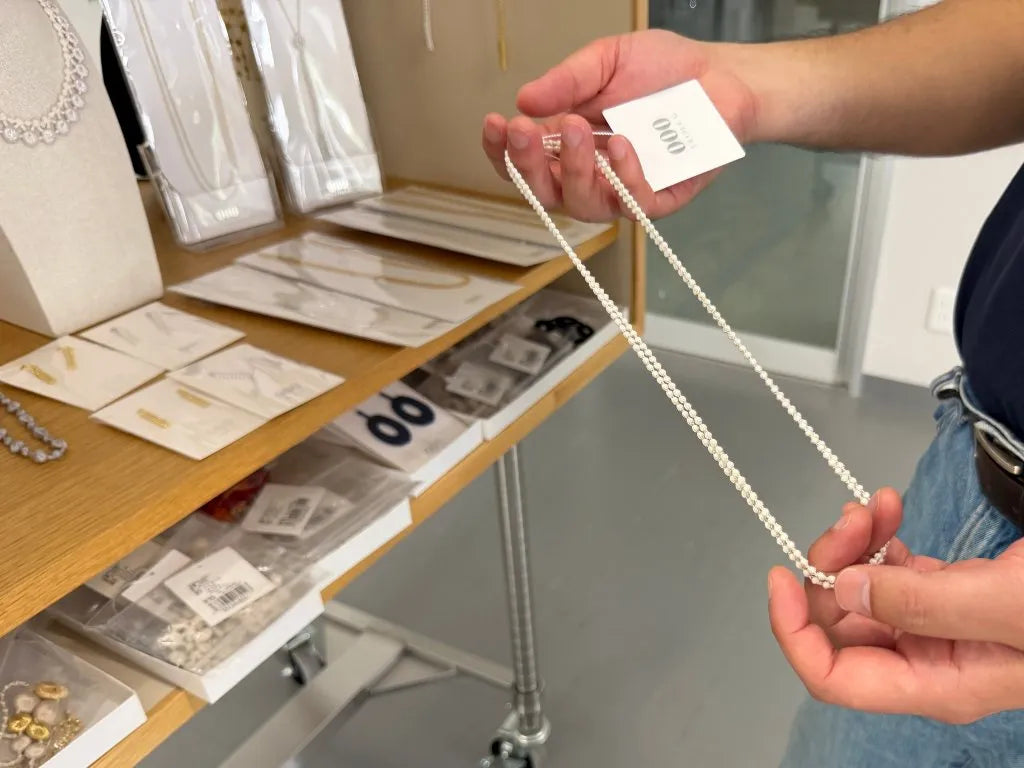
"So light!" That was our first reaction when we held a 000 (Triple O) necklace in our palm. Made entirely of thread, it weighs just two grams. Pearl-like beads line up in a row, and when it moves, the colors and metallic threads seem to glow from within.

Triple O is made by Kasamori, an embroidery company founded in 1877 in Kiryu, Gunma, a city long known for its textiles. Why would a 140-year-old weaving and embroidery company start making thread accessories, and what goes into each tiny bead? We visited the factory and spoke with Mr. Arai from the sales team. The story, it turned out, was full of surprises.
A chance meeting at the lowest point
Kasamori began as a weaver of obi sashes, then moved into embroidery, supporting countless apparel brands. In the 1990s, as clothing production moved overseas, embroidery work collapsed. An overseas factory had to be closed, leaving the company with debt. "We had to create work that could only be done in Japan."

Around then, textile designer Yoichi Katakura, who had been selling designs through an agent in London, visited Kiryu, drawn by its network of small specialist workshops: thread makers, twisters, dyers. A Kiryu-born textile designer told him, "What you want to do, Kasamori could probably do." At Kasamori, Mr. Katakura found a rare machine, one of only a few in Japan, that could laser-cut and embroider at the same time. Sensing it could make something entirely new, he joined the company. The result was KASAMORI LACE, embroidered parts shipped to fashion brands abroad to be sewn onto garments there.

Only the necklaces sold
KASAMORI LACE grew into the company's own brand, 000. At first it was a lifestyle brand that also made bags and kitchen mats. The turning point came at an event at a long-established department store. "We brought all kinds of things, and this was the only thing that sold," Mr. Arai laughs. Nobody looked at the bags or mats, but about 100 embroidered necklaces sold. That success gave the whole company confidence, and Triple O became an accessory brand.

Two years to make one bead
"Could we make a three-dimensional bead, like a pearl, from thread alone?" Embroidering small dots on fabric was possible, but nobody had ever made a freestanding bead purely from thread. "At first, everything was a failure." By day the machines made orders for apparel brands; at night, the team used the spare hours for trial after trial. After about two years, the thread-only bead necklace was finally complete.

At a trade show, the necklaces caught the eye of Nakagawa Masashichi Shoten, a well-known Japanese crafts retailer, which began stocking them. Feedback on colors and shapes went straight into new products, and orders slowly grew.
Customers found the real value
The team wanted to share how remarkable the embroidery technique was. But customers said something else: "They're so light, my shoulders don't get stiff." "I have a metal allergy, and I can wear these." "We never imagined that being light, with almost no metal, would be what people loved," says Mr. Arai. The team went on to make them lighter still and to refine the clasps.

Then, around 2015, Nakagawa Masashichi Shoten suddenly asked to stock them in every store. "We were only making them for an hour each night!" The big order changed the company's mindset, and it hired staff and set up full-scale production.
The glasses cord nobody planned
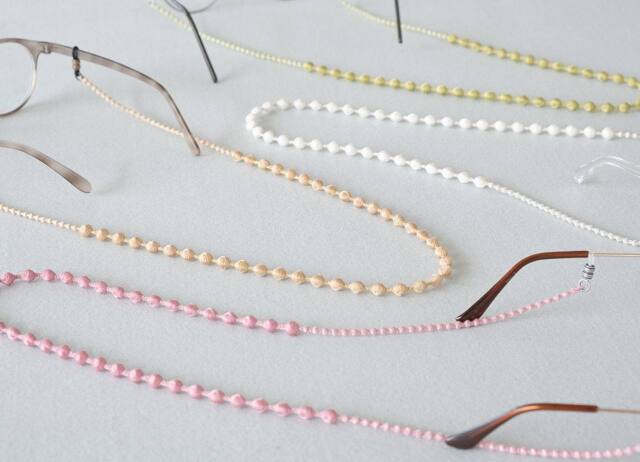
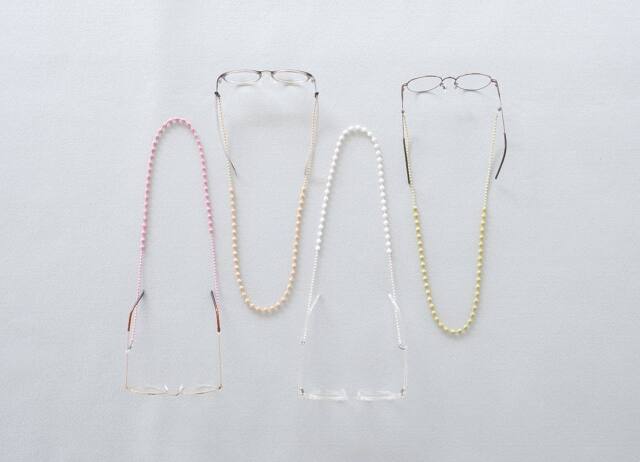
Customers kept asking for a glasses cord. As a fashion brand, the team was reluctant at first, but the requests continued, so they tried three colors. "This is exactly what we've been waiting for!" came the reply, and inquiries poured in at trade shows. "We were lucky," Mr. Arai says. "It taught us to really listen to our customers."

How a thread accessory is made
- A water-soluble base. The embroidery is stitched onto a special sheet that dissolves in water, leaving only thread. The sheet is sensitive to humidity, so thread tension and machine settings are adjusted to each day's conditions.
- The frame moves, not the needle. The needle stays in place while the frame holding the sheet moves as programmed, drawing circles and curves as the thread slowly builds up into shape.
- 20,000 stitches per necklace. Every stitch is programmed. The hardest part for operators is balancing the tension of the upper and lower threads; the slightest imbalance ruins the shape.
- Slow on purpose. The machines can run at 1,000 stitches a minute but are run at about 500, because faster speeds distort the beads. When a thread breaks, the craftsperson finds exactly where, and backs up a few stitches to resume.
- Finished by hand. After the sheet is dissolved, each of the roughly 80 beads in a necklace is checked by eye, and stray thread ends are tucked inside before trimming so they will not fray.
- Steam-pressed into shape. Each piece is gently steamed and stretched straight. At home, a little steam or a spritz of water and hanging to dry is enough to remove kinks.
- Clasps, packing and inspection. Some clasp rings differ by just 0.1 mm. Every piece is packed facing the same way, checked for stray threads, and passed through a needle detector.


"I wanted to make this brand's products"
We were surprised by how many young craftspeople work at the factory. One 18-year-old, who handles thread tension for earrings made with gold thread, discovered Triple O while studying textiles at school. "I thought, this company is doing something really unusual." More and more young people now apply because they want to make Triple O products.

Kiryu, another stroke of luck
Deep in the factory, a wall of shelves holds more than 600 colors of thread, some made exclusively for Triple O. One metallic thread, for example, has a glittering core wrapped in another thread, because nothing on the market gave the right look. "Kiryu has thread makers, twisters and dyers, so we can develop thread together. A thread this unusual might be turned down elsewhere, but here people say, 'Sounds interesting, let's try.' This brand couldn't exist anywhere but Kiryu."

Kasamori also opens its factory to the public once a year, and makes accessories from silk grown in Gunma. "If nobody uses Gunma silk, that culture will disappear. We hope our products make people curious about Kiryu and silk."
A name that carries tradition forward
A large tapestry made for the company's 140th anniversary hangs in the factory, with all the connecting threads left in place on purpose. The name 000 has a similar meaning. "When we started the brand, the company was about 130 years old. We wanted to reset that history to zero, but keep the digits: carry the tradition forward while starting fresh." Remarkably, the name and logo came before the beads. Three circles, and later a bead that matched them perfectly.


Luck, earned through passion
"I don't know how we got here. It just happened. We were lucky," Mr. Arai told us more than once. Perhaps. But it is luck earned by facing each challenge head-on, and by a company with over a century of history that kept changing and kept trying. What's next? "We want to keep offering value only Triple O can, and perhaps share embroidery in new ways, like products for children. We never know what will work, but we'll keep trying what we find interesting."

Light and beautiful, a Triple O accessory might bring a little unexpected joy into your everyday life too. Our thanks to Mr. Arai and everyone at Kasamori.


%20necklace%20in%20our%20palm.%20Made%20entirely%20of%20thread,%20it%20weighs%20just%20two%20grams.%20Pearl-like%20beads%20line%20up%20in%20a%20row,%20and%20when%20it%20moves,%20...)