

4th-market: Everyday Banko Ware from Yokkaichi
4th-market is a ceramics brand born in 2005 in Yokkaichi, Mie Prefecture. The name is a playful English translation of the city's name (yokka means "fourth day," ichi means "market"), and also a nod to the four kilns that founded it. For our second visit, we went to one of the kilns that makes its products.

Banko ware: built for heat
Yokkaichi is the home of Banko ware, a designated Traditional Craft of Japan. Its defining feature is heat resistance: a mineral called petalite is mixed into the clay, so the pottery can go straight onto a flame. Teapots and clay pots are its specialties, and Yokkaichi makes about 80% of Japan's donabe clay pots.

4th-market designs all of its own tableware and cookware around Banko ware's strengths, with "everyday use" as its theme: simple yet stylish pieces whose look and feel you grow fonder of each time you use them.

We spoke with Mr. Takeuchi, the fifth-generation head of Takemasa Seito, one of the kilns behind 4th-market.

A craft that keeps changing
"Banko ware started with teapots," Mr. Takeuchi explains. "Then came charcoal braziers and lacquer-style boxes, then vases, then clay pots, and alongside them a lot of Western tableware." His own kiln has long specialized in herbal decoction pots, used to brew traditional medicine without the metal affecting it. "Hardly anyone makes these anymore."

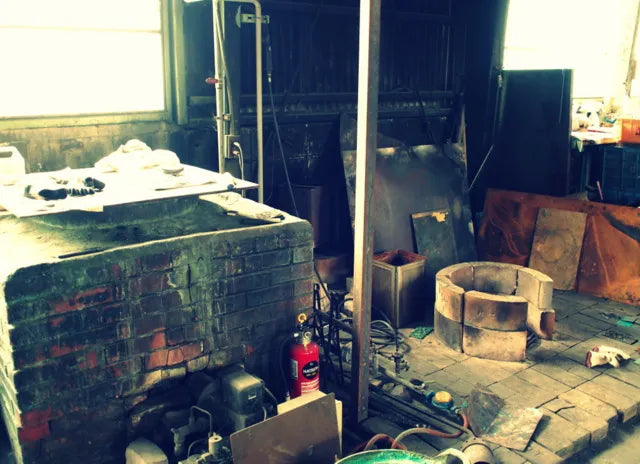
In the workshop, spouts and knobs are shaped separately and joined to the body with slip, liquid clay that works like glue. To stop the joints cracking as the clay shrinks in the kiln, the slip is made from the very same clay as the pot. Pottery, we realized, is a long chain of delicate steps.
A pottery town without its own clay
Yokkaichi is an unusual place for pottery. "Most pottery regions are in the mountains, where good clay can be dug and there are climbing kilns. Here we can't dig clay at all, and the sea is right there." Instead, raw materials were gathered from around the world through the nearby port and blended into new clays: heat-resistant bodies, semi-porcelain and more. "So when someone tries something new, nobody here finds it strange."

New challenges
Rising fuel prices weigh heavily: a large gas tank can be emptied by a single firing of one kiln. Petalite has become a problem too. The Zimbabwean mine that supplied it was bought by a company seeking its lithium for electric-vehicle batteries. For a time almost none reached Japan, and it now costs about eight times what it once did. Pottery regions across Japan, including Seto, Mino and Tokoname, are working together on the problem, which has even been raised in Japan's parliament. "That was probably the first time anyone said 'petalite' in the Diet," he laughs.

Long-life design, and the fun of trying
After 20 years, the brand's concept has not changed: to make challenging pieces others would not attempt, and long-life products people use for years. The kiln's herbal decoction pot, first made by the third generation, has been produced unchanged for about 60 years. "Creating long-life designs like this is a goal for 4th-market today."

Lifestyles change, and so do the tools people need. The brand's rice cooker pot is one example. "To us, cooking rice in a donabe was obvious, so we never thought of a dedicated rice pot. But most people didn't picture cooking rice in a clay pot. A pot made just for rice could bring it into more homes." Rice cooked in a clay pot really is delicious.

Products need a heart
Many 4th-market pieces take real effort, such as original glazes developed with a glaze maker for each concept. "4th-market started so we could keep making products we love for as long as we want, and tell our craftsmen it's fine to take their time. Making new things is hard, but it's fun if you can enjoy it. When customers respond well, you start to love that product, even if you complained about it before," he laughs.

His family motto is issho ippin: make at least one piece in your lifetime worth leaving to future generations. "Everyone has a favorite mug they reach for every morning. It's about feel: how it sits in your hand, how it touches your lips. I'd love to make a mug that anyone would pick up and say, 'This is perfect.'"

Blending into changing lifestyles while adding a little color to every day, 4th-market's pieces carry the care of their makers. We look forward to what they make next. Our thanks to Mr. Takeuchi for his time.


,%20and%20also%20a%20no...)