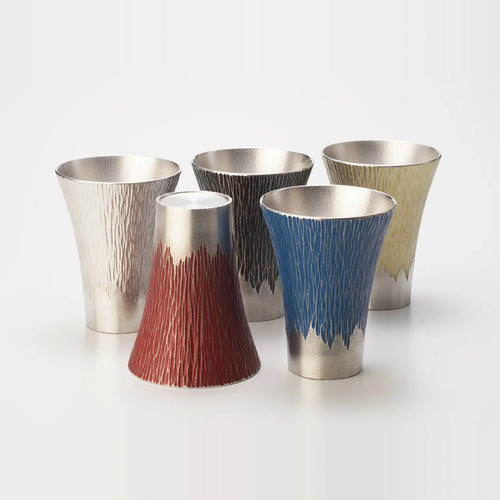
Made by Osaka Suzuki · Higashisumiyoshi, Osaka
Senju Tin Tea Caddy | OSAKA SUZUKI
We will do our best to follow your wrapping preferences, but depending on the shape of the item or other circumstances, we may not always be able to meet them. We are unable to accept returns or exchanges because the wrapping differs from your request.
Ships from Japan by EMS with tracking
In-stock items ship within 3–5 business days. Made-to-order items may take longer — we will email you if so.
Shipping credit on larger orders: ¥1,000 off over ¥20,000 — up to ¥2,500 off over ¥50,000.
Shipping is calculated by weight at checkout. See estimated rates →

Meet the maker
Higashisumiyoshi, Osaka
A tinware maker founded in 1949 in Osaka that produces nearly all of Osaka Naniwa Suzuki, a designated Traditional Craft of Japan...
Choose options

Airtight Seal Created by Craftsman's Skill
The role of a tea caddy is to preserve tea leaves in the best condition. Airtightness is essential to maintain the aroma of tea leaves. An outstanding feature of tin tea caddies is their excellent airtightness. When you place the lid on the tea caddy, it gradually descends with a soft "swoosh" sound as air escapes. This is proof of its airtightness and a very satisfying moment.

This precision can only be achieved by skilled craftsmen. The caddy is crafted by turning and carving from a single piece of tin, but actually, only a select few among Osaka tin craftsmen can make them. This is truly the ultimate tea caddy made possible only through the skills of master craftsmen.
Preservation Possible Only with Tin
Why do tin tea caddies keep the "taste" and "aroma" of tea leaves fresh for longer? The key is how to protect tea leaves from "oxygen," "moisture," and "sunlight." For example, wooden or ceramic containers allow air to pass through and cannot be sealed. Transparent containers expose tea to sunlight and of course, allow air permeability.
What about other metals like copper, tin plate, or stainless steel? The biggest difference between these metals and tin is in the manufacturing process.

In the case of tin, it is carved out from a single piece using a lathe. In contrast, other metals are typically formed by rolling a sheet into a cylinder and joining it together.
Tin tea caddies naturally have higher airtightness, resulting in a seamless finish. Additionally, tin itself is resistant to oxidation and does not rust. As the material is durable, the product can be used for almost a lifetime.

■ Product Size

■ Product Details
The double-lid structure enhances airtightness.

Since it prevents aromas from escaping, it's also recommended for coffee beans.

There is no gap between the body and lid.

The beautiful polishing creates a brilliant shine.

■ Safety Assurance
Tin products such as tea utensils manufactured by Osaka Pewter can be used safely. They have been analyzed and found to have test results below the standard values for each item in Public Notice No. 370 "Metal Can Standards."
Test Certificate Issuance Date: May 14, 2003 Test Certificate Issue Number: No. 203042040-001 Test Commissioned to: Japan Food Analysis Center

The maker behind this piece
Osaka Suzuki
Higashisumiyoshi, Osaka
A tinware maker founded in 1949 in Osaka that produces nearly all of Osaka Naniwa Suzuki, a designated Traditional Craft of Japan with over 300 years of history. Its craftsmen, many of them young, turn tin into tumblers, sake cups and tea caddies by hand.